

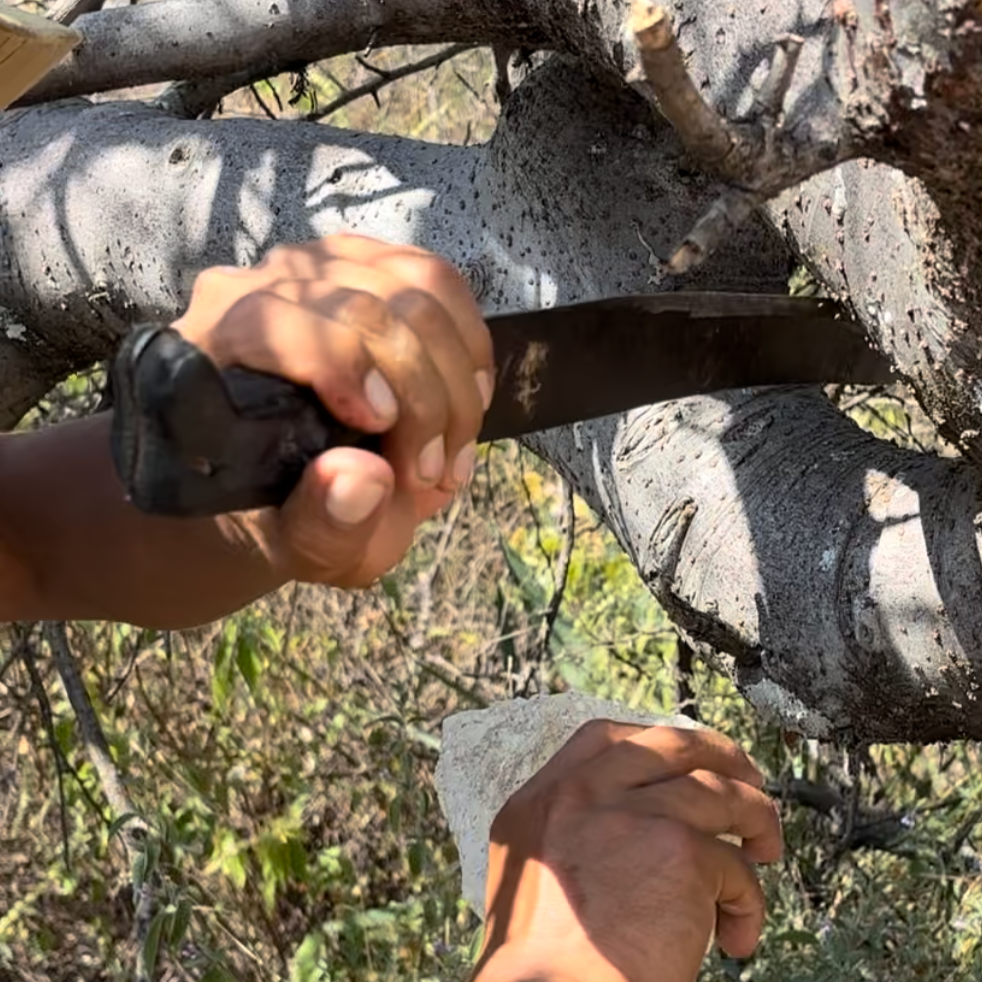
Copal — the resin of Bursera trees native to Mexico — doesn't arrive all at once. It's asked for, a little at a time, over months — and what happens after the harvest matters just as much as the harvest itself.
The Cut
The harvest happens during the rainy season, when mature trees have water and life enough to give. It isn't a single incision. Harvesters cut a small V into the bark, and return every few days to make a new cut just above the last one, moving gradually upward — as many as eleven cuts over two weeks. Not a wound meant to harm, but one the tree can heal from. The resin seeps out slowly and hardens in the open air.
The same tree isn't asked again right away. It's given time to recover — often two years or more — before it's cut a second time. It's not a rule anyone invented. It's simply what the tree has always required, and what the people who do this work have always respected.
Fresh Resin, Then Copal
What comes off the tree isn't yet what you'd recognize as copal. Freshly harvested, it's soft and sticky — closer to sap than stone. Left to rest in a cool, dry place, it slowly hardens. Its lighter compounds evaporate, and the deeper ones knit together, little by little, into something more solid and more concentrated.
This is the same reason our incense sticks rest for 7 to 10 days before they're ready — a small version of a much older process. Given more time — years, sometimes centuries — that same resin continues to change, deepening further into what's technically a semi-fossil. Given far more time than any of us will see, it becomes amber.
The scent changes with it. Fresher resin burns with a sharper, almost sap-like note. Given time to rest, the smoke turns whiter, sweeter, and rounder — less like the tree, more like what the tree was holding onto.
Real Resin, Real Smoke
Not everything sold as copal is copal. Some is stretched with paraffin — melted white candle wax blended in to make it go further. Others use pine resin, a common and cheaper substitute. And some is low-quality synthetic resin, coated on the outside with real copal so it smells right at the moment of buying.
Real copal, burned well, gives a clean white smoke with a bright, resinous scent. An imitation can be harder to catch — the difference is subtle enough that most people won't notice it right away. But with time and enough copal burned, the ones who know it well can usually tell within moments.
A Common Confusion: "White Copal" and Damar
Much of what's sold internationally as "Mexican White Copal" is actually Damar resin — native to Southeast Asia, from a different tree, and part of a different tradition altogether. That doesn't make Damar a lesser resin. It's simply not the same tree, or the same tradition.
Temple Copal doesn't need to say other resins are false. We'd rather be clear about what we share: real Mexican copal, gathered by the families and cooperatives who have kept this tradition alive for generations — knowing where something comes from, and calling it by its name.
The Kinds of Copal We Work With
White Copal
The lightest and most common. Bright top notes of lemon and lime, a heart of wild pine, and a faintly sweet, earthy base.
Dark Copal (also known as Gray)
Resin exposed longer to sun, air, or the natural wear of the forest. Denser, smokier, more resinous — a heavier presence in the room.
In Spanish, "copal" simply means "resin" — and Mexico is home to far more of it than these. Worldwide, more than 12,000 tree species produce some form of resin; many of them grow right here. What we share is the copal our cooperatives know best.
A Tradition Bigger Than a Season
Copal harvesting sits inside a much older relationship between people and this particular family of trees — one that also shaped other traditions, like the carved, lacquered woodwork of Olinalá, made from a related aromatic wood. None of it happens without care for the forest itself: the cutting is regulated, the trees are given time to recover, and the people who do this work are, in a very real sense, its guardians.
What we offer at Temple Copal is a small piece of that — gathered with patience, and carried forward with the same care it has always asked for.